This year, the Alliance delivered on its strategic plan of a strong network, strengthening advocacy and accountability, and building members’ capacity to turn evidence into action, ensuring global road safety commitments translate into safe journeys worldwide. From leading NGO advocacy at the 4th Global Ministerial Conference on Road Safety (Ministerial Conference), where we monitored and analyzed government commitments, to advancing the implementation of 30 km/h interventions across Africa, Asia, and Latin America, the Alliance amplified NGO voices, elevated lived realities on the road, and pushed for the adoption of proven, evidence-based interventions. Below are some of our key highlights of 2025.

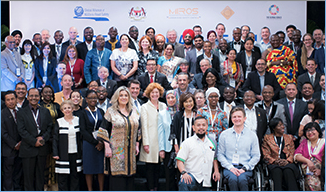
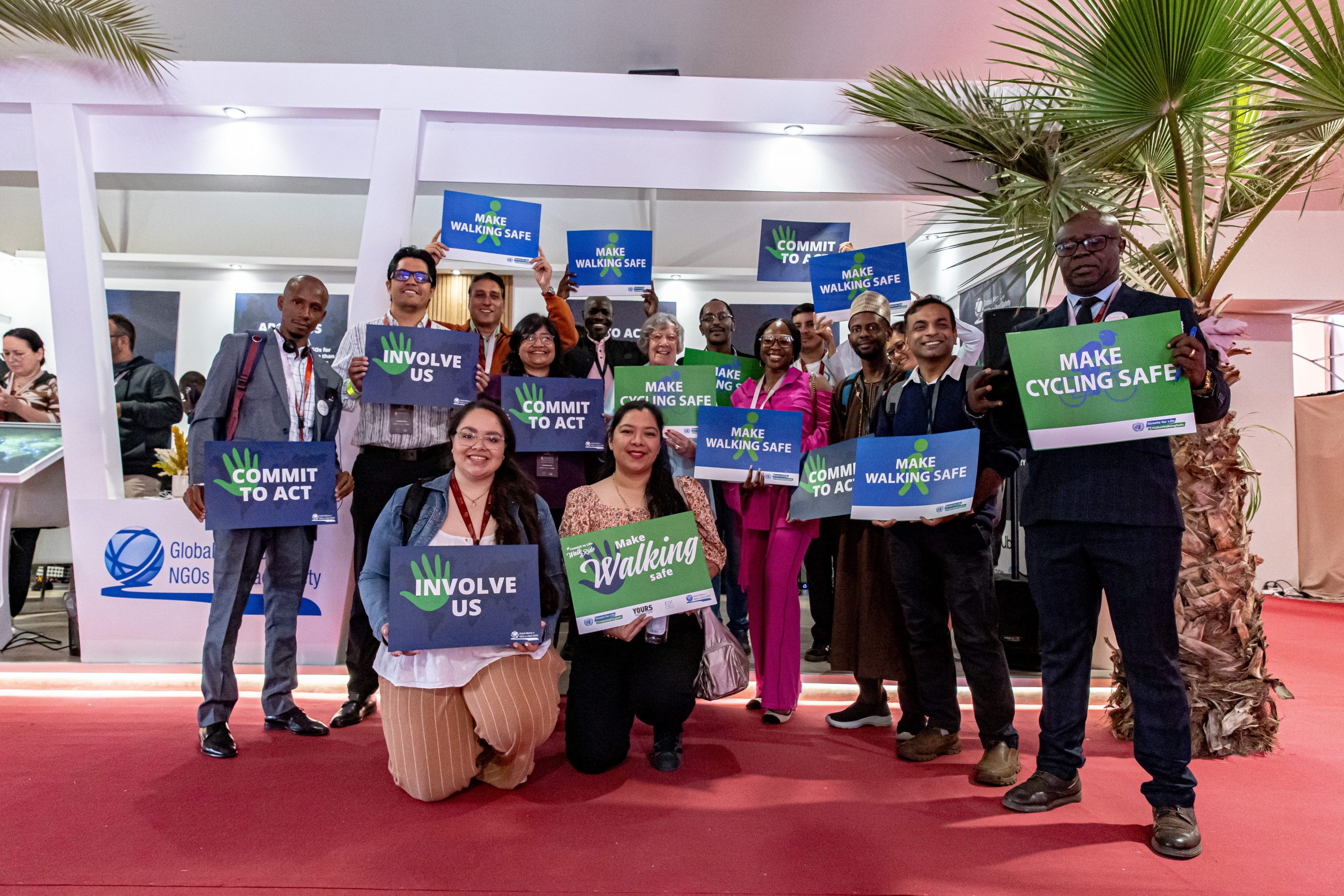
At the Ministerial Conference in Marrakech, the Alliance and its members ensured civil society’s voice was clearly heard. By invitation of the organizers, the Alliance led a parallel session on Commitments and Accountability, reflecting growing recognition of NGO leadership in advancing accountability in road safety.
Alliance members played an active role throughout the conference—speaking on panels, engaging with government delegations, giving media interviews, and using signboards to amplify key messages. The NGO Symposium and the side event Helmet Realities and Solutions highlighted NGO advocacy for evidence-based solutions. The Alliance booth served as a hub for members to meet national delegations, share lived realities from their streets, and discuss solutions; at least ten heads of delegation visited the booth, often alongside NGOs from their countries.
Alliance Executive Director Lotte Brondum was invited to speak at the closing ceremony, placing the NGO Call to Action for government commitment and accountability at the center of her remarks and symbolizing it through a safe mobility artwork presented to the Government of Morocco. Following the conference, the Alliance analyzed government commitments and the Marrakech Declaration against its Call to Action, sharing the findings in an online session and discussing how NGOs can use the analysis to monitor commitments, engage decision-makers, and drive accountability. Recap the Alliance’s activities at the Ministerial Conference HERE.
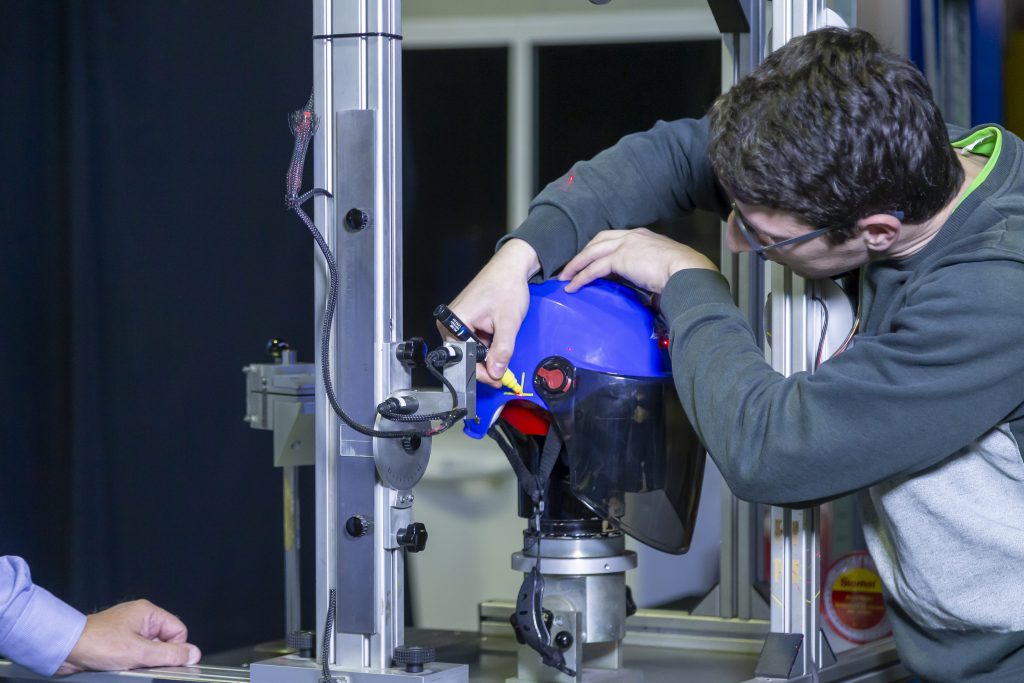
“These substandard helmets are everywhere in the local market, selling for around US$12. Sadly, the lab results weren’t surprising; safety standards here often seem like a checkbox exercise rather than a real priority.” Mesganaw Bimrew, Save the Nation, Ethiopia.
The Alliance launched its Helmet White Paper and convened a side event on safe and affordable helmets at the Ministerial Conference in Marrakech. Bringing together NGOs, technical experts, governments, and the private sector, the Alliance contributed to strengthening collaboration with stakeholders to expose real world safety gaps and drive accountability.
To ground the discussion and advocacy in lived realities, Alliance member NGOs sourced 11 motorcycle helmets from local shops or riders in Benin, Côte d’Ivoire, Ethiopia, Ghana, Greece, India, Kenya, Mexico, Nigeria, and Vietnam. These helmets were placed at the Alliance booth for participants and government delegations to touch and feel after which they were sent to an accredited laboratory for testing against three core safety tests common to global standards, including UN Regulation No. 22 (ECE 22.06). None passed all three tests, and only one passed a single test.
The results revealed that unsafe helmets are widely available across multiple countries, exposing critical gaps in standards, enforcement, and market surveillance. The findings reinforced a clear NGO message: protecting motorcyclists requires not just helmet laws, but helmets that actually protect. Recap the helmet testing results HERE and NGO reactions HERE.
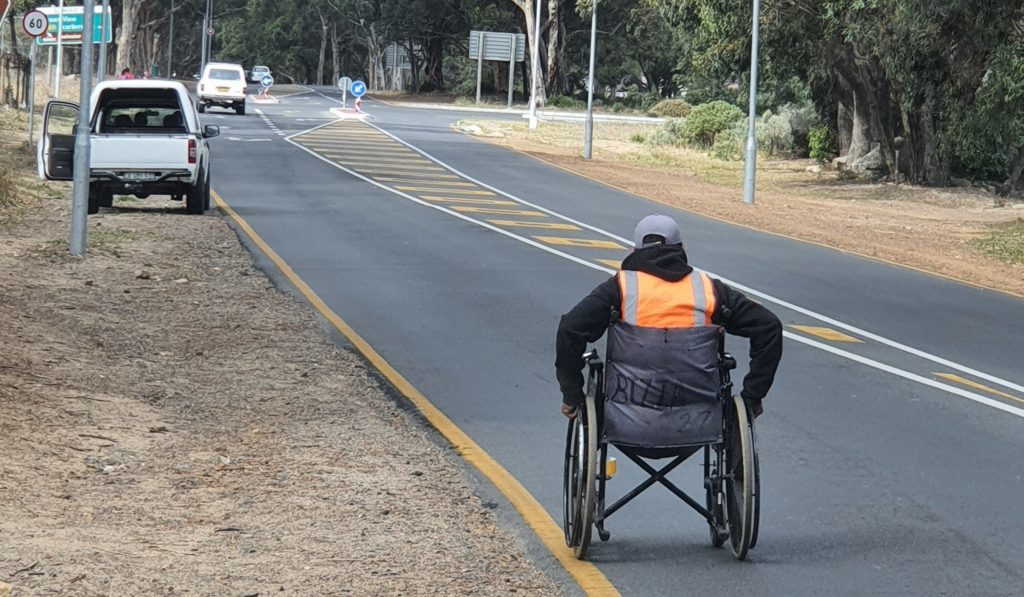
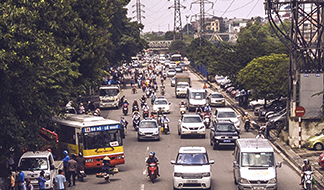
The Mobility Snapshot continued to transform everyday street realities into compelling evidence for change, revealing a shared global failure to prioritize people on roads—across different countries, cultures, and contexts.
Launched at the Ministerial Conference in Marrakech, the Mobility Snapshot publication showcased over 118 snapshots from intersections used by millions of people in more than 44 countries across six continents. The snapshots documented the daily risks faced by pedestrians, giving NGOs concrete, people-centered evidence to engage decision-makers.
This led to tangible, on-the-ground improvements in many countries. In Cape Town, South Africa, Mobility Snapshot advocacy contributed to the construction of safe footpaths and bicycle lanes on a busy street where Shelwyn, a wheelchair user, was forced to navigate traffic. In Chișinău, Moldova, it helped secure the implementation of 30 km/h limits, pedestrian crossings, and traffic calming, while in Dar es Salaam, Tanzania, it contributed to the installation of pedestrian crossings.
Read more about the Mobility Snapshot HERE.

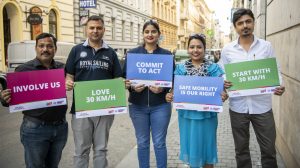
The Alliance launched a case study publication titled Making 30 km/h a reality: A case study of advocacy in Kenya and Uganda using the Accountability Toolkit, showing how NGOs are driving policy change and implementation of 30 km/h zones, a proven intervention to reduce road deaths and injuries and advance the Global Plan for the Decade of Action for Road Safety 2021–2030.
The case study follows Alliance members in Kenya and Uganda who used the Accountability Toolkit to influence government action. In Kenya, the government committed to 30 km/h zones as a policy priority and initiated a review of the Traffic Act to make 30 km/h the default urban speed limit. In Uganda, regulations lowering urban speed limits from 50 km/h to 30 km/h were reviewed and gazetted.
The publication is complemented by a new Toolkit webpage, Lessons learned: Real-world application of the Accountability Toolkit for 30 km/h zones, which captures insights from NGOs in Argentina, Chile, Kenya, Nepal, Tanzania, Tunisia, and Uganda participating in the Alliance Incubator program, demonstrating how tools such as the Accountability Toolkit can turn commitments into safe streets.
As 2025 comes to a close, these milestones reflect the growing impact of NGOs when equipped with evidence, tools, and a collective voice. From global policy spaces to local street transformations, Alliance members continue to demonstrate that safe mobility is achievable when commitments are matched with action.
Looking ahead, the Alliance remains focused on supporting NGOs to drive accountability, influence policy, and deliver evidence-based interventions that save lives on the road.